Categories
Uncategorized

ESG & REGULATORY COMPLIANCE

ESG & REGULATORY COMPLIANCE

Regulated public and corporate entities in Kenya are required to conduct their business affairs full compliance with the Constitution, all applicable sector legislation, regulations and processes. The ramifications of non-compliance are far reaching both for the institutions and officers involved.

The firm has built strategic capacity in this area to assist both public sector clients as well as private sector players that have engagements with public bodies. The practice area is one of the fastest growing components of the firm’s practice and is overseen by a highly experienced team of lawyers with expertise in various aspects of public sector administration including policy formulation, different categories of compliance audits as well as legislative drafting.

Building on the unique advantage that the firm enjoys as one of the few firms with an elaborate offering in the area, the team continues to add to the firm’s market leadership status. The categories of clients that frequently engage the firm in relation to this practice area include State Corporations, National Government Ministries, County Governments and Assemblies, investors and public listed companies.

Legal, Environmental, Social, and Governance (ESG) & Regulatory Compliance

We guide  companies to prepare for a decarbonized and carbon neutral future by assessing their current Environmental, Social, and Governance (ESG) impacts, creating Science-Based Targets, and engaging effectively with key stakeholders.

Our lawyers advise clients across all sectors on ESG risks and compliance measures, helping businesses manage their risks more effectively while becoming more competitive in the market. We have extensive knowledge of sustainable performance-related laws and regulations, standards and initiatives and are able to advise clients on fulfilling their corporate ESG commitments.

We also conduct:

a) Training & Sensitization Seminars

We train the management on corporate governance practices, and publicize legislative and regulatory changes an affecting the industry.

b) Developing and Monitoring Compliance with Policies

We assist corporates, NGOs and public bodies to develop policies and monitor compliance with the procedure and policies (i.e. the employment handbook, sexual harassment policy, the disciplinary policy etc.)

We further assist in developing, maintaining and regularly update RISK MANAGEMENT Policies and procedures through LEGAL AUDITS for all functionalities such as procurement and review the SOPs (Standard Operating Procedures).
Categories
Uncategorized

Real Estate Law in Kenya

Real Estate Law in Kenya: Real Estate, Conveyancing & Construction

At WKA Advocates, we specialize in real estate law in Kenya, offering services that include negotiating, preparing, reviewing, and stamping Sale, Lease & Tenancy Agreements, Joint Venture Agreements, and JBCC & FIDIC Building Contracts.

In Kenya, the process of buying and selling land is fraught with risks. Without proper due diligence, buyers risk acquiring property with multiple title allocations or a chain of ownership tainted by fraud or illegality.

WKA Advocates has in-depth knowledge of Kenya’s land laws, providing practical guidance throughout the entire process. We understand that even minor errors or misjudgments can lead to significant losses or deal breakdowns. Therefore, we ensure our clients enter transactions fully aware of all potential outcomes.

We also cater to a robust clientele in the Diaspora, assisting them in locating properties, making investments, and conducting thorough due diligence. From negotiating the letter of offer to handing over the keys at completion, we guide clients through every step of their property transactions.

In our experience, the biggest challenges in Kenya’s real estate industry today are the lack of integrity and widespread misinformation. At WKA, we bridge this gap by continuously educating our clients on the law and recent developments. For example, as of December 2021, purchasers of apartments now receive a Sectional Title Deed instead of a Long Term Lease, thanks to the Sectional Properties Act No. 21 of 2020. This change makes owning an apartment akin to owning land, with a Title Deed that can be used as collateral for loans.

Our expertise extends to high net worth real estate developments in Kenya, including notable projects like Tatu City, Purple Haze, Siaya Park, and Diamond Homes.

Categories
Uncategorized

Leading Intellectual Property Law Firm in Kenya

Leading Intellectual Property Law Firm in Kenya

WKA Advocates is a premier intellectual property law firm in Kenya. Our team of specialized intellectual property and franchising lawyers works closely with clients to develop, protect, promote, and enforce their intellectual property rights.

What is Intellectual Property?

According to the World Intellectual Property Organization (WIPO), Intellectual Property (IP) refers to creations of the mind, such as inventions used in commerce. The key difference between innovation and invention is that innovation involves translating an idea or invention into a product or service that provides value or that customers are willing to pay for. An invention, on the other hand, is a new scientific or technical idea and the means of its embodiment.

Kenya’s Intellectual Property Landscape

In 2020, the Government of Kenya introduced the Intellectual Property Bill, which aimed to strengthen policy control around IP enforcement. This bill merged three key IP-related agencies—the Kenya Copyright Board (KECOBO), Kenya Industrial Property Institute (KIPI), and the Anti-Counterfeiting Agency (ACA)—to establish a unified Intellectual Property Office of Kenya (IPOK).

Article 40(5) of the Constitution of Kenya, 2010, mandates the government to support, promote, and protect the intellectual property rights of its citizens. Kenya’s legislative framework is designed to safeguard the ownership of intellectual property, fully complying with international standards as outlined by the Agreement on Trade-Related Aspects of Intellectual Property Rights (TRIPS).

Key Government Agencies in Intellectual Property Rights

Several government agencies play critical roles in protecting intellectual property rights in Kenya:

Categories
real estate

Conveyancing and Real Estate

Conveyancing Law and Practice in Kenya

With years of experience in land law and property transactions across Kenya and the broader Eastern Africa region, our firm is well-equipped to handle all aspects of property law. Our expertise covers land and property acquisition, management, and disposal, ensuring our clients receive strategic and practical advice tailored to their specific needs.

Expertise in Conveyancing & Real Estate in Kenya

Our Conveyancing & Real Estate practice group has extensive experience in advising both local and international clients on various property-related matters. We specialize in:

  • Land Acquisition and Disposal: Providing expert guidance on acquiring and selling land in Kenya.
  • Conveyancing: Handling the entire conveyancing process, including drafting conveyancing documents and managing the legal transfer of property.
  • Commercial & Residential Development: Advising on development projects, including project financing and joint ventures.
  • Leases and Licenses: Structuring and drafting lease agreements for both commercial and residential properties.
  • Project Financing: Offering solutions for financing real estate projects, ensuring compliance with legal requirements.

Understanding the Conveyancing Process in Kenya

Navigating the conveyancing process in Kenya requires careful attention to detail. We assist clients with:

  • Conveyancing Documents: Drafting and reviewing all necessary documents to ensure a smooth transaction.
  • Completion Documents: Ensuring that all required documents are completed and properly executed.
  • Off-Plan Conveyancing: Managing transactions for properties that are yet to be fully developed, ensuring that clients’ interests are protected.

Avoiding Pitfalls in Land and Property Transactions in Kenya

Our guide helps you avoid common mistakes when buying land or property in Kenya:

Don’ts:

  • Avoid Sending Money Directly to the Seller: Always route payments through your advocate to ensure a proper money trail.
  • Don’t Bypass Legal Advice: Involve a qualified advocate in all transactions to avoid legal pitfalls.
  • Don’t Rely Solely on Adverts: Conduct thorough due diligence, including background checks on sellers.

Do’s:

  • Conduct a Site Visit: Verify the land’s condition with a physical visit or through your power of attorney.
  • Engage a Surveyor: Have a qualified surveyor mark the land boundaries.
  • Keep Written Records: Document all agreements and conversations in writing for future reference.
Categories
Uncategorized

President Uhuru Kenyatta Signs the Military Veterans Bill into Law

President Uhuru Kenyatta Signs the Military Veterans Bill into Law

On June 15, 2022, President Uhuru Kenyatta signed into law the Military Veterans Bill, 2022 (Military Veterans Act, 2022). This legislation comes at a critical time when the world is grappling with a global mental health crisis. Many retired servicemen have reported suffering from physical and mental trauma, including post-traumatic stress disorder (PTSD), due to the challenging conditions faced during their service. Concerns have been raised over the lack of a comprehensive legal framework to address the special needs of these veterans after retirement. The most publicized mental health challenges facing veteran service members are PTSD and depression. Research suggests that approximately 14% to 16% of U.S. service members deployed to Afghanistan and Iraq have PTSD or depression, and the situation is similar in Kenya.

Key Features of the Military Veterans Act, 2022

Comprehensive Support for Veterans

Proposed by the Leader of the Majority, Hon. Amos Kimunya, this newly signed law aims to improve the quality of life for military veterans (vets) and their dependents. The law covers all those who retired after serving in the Kenya Defence Forces (KDF) and its precursor, the pre-colonial unit named Kenya African Rifles. It applies to those who receive a military pension and were not dishonorably discharged from military service. Veterans discharged on medical grounds will also receive benefits under the Act.

Regulatory and Institutional Framework

The Act establishes a regulatory and institutional framework for managing military veterans’ affairs, including the creation of the Dependants’ Education Fund (DEF) by the Defence Council. The Defence Council, chaired by the Defence Cabinet Secretary, includes the Chief of the Kenya Defence Forces, the commanders of the Air Force, Navy, and Army, and the Defence Principal Secretary. This council is the primary decision-making body for veterans’ affairs.

Defence Forces Retirement Home

The Act also establishes the Defence Forces Retirement Home (the Home), where the Defence Council will determine eligibility for accommodation, services provided, and required contributions. Serving members will contribute to the establishment and maintenance of the Home.

Director of Military Veterans

A Director of Military Veterans, appointed by the Defence Council, will oversee the administrative duties of the DEF and the Home, operating under the Chief of Defence Forces.

Advisory Committee on Military Veterans

An Advisory Committee on Military Veterans will be established to advise and make recommendations to the Defence Council, Cabinet Secretary, or Director of Military Veterans on matters related to veterans and their dependents.

Policy Development and Implementation

The Defence Council is empowered to develop policies on military veterans and consider proposals from the Cabinet Secretary, Chief of Defence Forces, or Director of Military Veterans regarding funding and budgeting for veterans’ affairs. Clause 23 of the Act grants the Cabinet Secretary the authority to make regulations for the enactment and implementation of the Act’s provisions.

Conclusion

The Military Veterans Act, 2022, is a significant step toward recognizing and addressing the needs of Kenya’s retired servicemen and their families. Viva to our soldiers and decorated veterans! The rewards of patriotism are within reach.

For further information or legal assistance on compliance or any other legal issue, please contact us at info@wka.co.ke or visit wakilihub.co.ke/. Our Nairobi hub is located at Parklands, Valley View Business Park, 6th Floor, City Park Drive, Off Limuru Road.

Please note that the contents of this newsletter are intended to provide a general guide to the subject matter and should not be relied upon without legal advice.

Categories
Uncategorized

To Guarantee or Not? Rights of Loan Guarantors in Kenya

Loan Guarantors in Kenya: Should You Guarantee or Not?

So, you’ve joined the SACCO your friend recommended. After building up some savings, the same friend asks you to be their loan guarantor. One afternoon at your favorite four-star kiosk, “kibandaski,” they casually mention needing KES 500,000 for a project back home and ask you to guarantee KES 200,000. Without thinking, you sign the loan forms, wondering, “What could possibly go wrong?”

Months later, your salary and SACCO shares are being deducted to cover your friend’s loan, which they spent on a holiday to the Mara. You’re now left with half your salary while your friend enjoys a luxurious lifestyle.

The Big Question: Should You Guarantee a Loan?

Applicable Laws on Loan Guarantees in Kenya

Loan guarantorship in Kenya is governed by:

  • The Constitution of Kenya, 2010
  • The Law of Contract Act, Cap 23 (LCA)
  • Case law (legal precedents)

What Does Kenyan Law Say About Guarantees?

The Law of Contract Act, Cap 23, defines a guarantee as a written promise by the guarantor to be responsible for a debtor’s obligations. Under Section 3(1) of the LCA:

“No suit shall be brought…unless the agreement…is in writing and signed by the party to be charged.”

In 2019, a proposed amendment to the LCA sought to ensure creditors first exhaust the debtor’s assets before suing the guarantor. However, the President rejected this amendment, citing concerns over its impact on credit availability for SMEs.

Rights of Loan Guarantors in Kenya Before Satisfying Debt

  1. Right to Property: Guarantors have the right to retain their property and cannot be arbitrarily deprived of it.
  2. Type of Guarantee: Guarantees can be “on-demand” (immediate payment) or “conditional” (payment only under certain conditions).
  3. Liability: A guarantor’s liability arises only when the principal debtor defaults.
  4. Right to Demand Payment: Guarantors can demand that the principal debtor pay the guaranteed debt.
  5. Right to Information: Guarantors are entitled to timely and accurate updates from the creditor on the status of the loan.

Effects of Changes in Loan Terms

  • Unauthorized Changes: If the creditor alters the contract without the guarantor’s consent, the guarantor may be discharged from their obligation.
  • Court Rulings: Key cases, like Reid vs. National Bank of Commerce (1971), affirm the guarantor’s right to be informed of changes to the contract.

Creditor’s Duty of Good Faith Towards Guarantors

  • Bad Faith by Creditors: If the creditor colludes with the principal debtor or acts in bad faith, the guarantor may be released from liability.
  • Relevant Case Law: Martin Kirima Baithambu vs. Jeremiah Miriti [2017] emphasizes the importance of creditors acting in good faith.

Defenses and Remedies for Loan Guarantors in Kenya

  • Variation of Contract: Unauthorized contract changes can release the guarantor from their obligations.
  • Release of Security: If the creditor releases the debtor’s security without the guarantor’s consent, the guarantor may no longer be liable.

Recommendations for Guarantors in Kenya

In Kenya, the law generally favors creditors over guarantors. The rejected 2019 amendment sought to redress this by requiring creditors to pursue the debtor’s assets first. Guarantors who pay off the loan can sue the principal debtor for reimbursement under the principle of subrogation.

Before signing any loan guarantee, seek legal advice and conduct thorough due diligence. Understand the potential financial risks of guaranteeing a loan.

For more information or legal assistance regarding loan guarantees or any other legal issues, contact us at:

WKA Advocates

  • Email: info@wka.co.ke
  • Website: wakilihub.co.ke/
  • Phone: +254 798 03 580
  • Address: Valley View Business Park, 6th Floor, City Park Drive, Off Limuru Road, Nairobi
Categories
real estate

How Can a Foreigner Own Property in Kenya?

How Can a Foreigner Own Property in Kenya?

Understanding Property Ownership for Foreigners in Kenya

For foreigners looking to invest in property in Kenya, it’s essential to understand the legal framework governing land ownership. Under the Constitution of Kenya (2010), the Lands Act (2012), and the Land Registration Act (2012), foreigners can own property but with certain restrictions. This article will clarify how foreigners can acquire property, the limitations in place, and common pitfalls to avoid.

Limitations on Property Ownership in Kenya for Foreigners

Foreigners can own property in Kenya only under leasehold tenure, with a maximum lease term of 99 years, as outlined in Article 65(1) of the Constitution. Any lease beyond 99 years is automatically considered a 99-year lease. Additionally, companies are regarded as Kenyan only if they are 100% owned by Kenyan citizens. Companies with foreign shareholders are classified as foreign entities and cannot own freehold land. Trusts cannot bypass these regulations, and any freehold interest held by a foreigner will revert to the state, which will grant a 99-year lease at a nominal rate.

Agricultural Land Ownership for Foreigners

According to the Land Control Act, transactions involving agricultural land are categorized as “controlled transactions” and require consent from the Land Control Board. This board cannot authorize sales, leases, or transfers of agricultural land to foreigners. However, foreign investors can apply for exemptions through a presidential notice in the Kenya Gazette. Public companies with foreign shareholders may also acquire agricultural land under specific conditions.

How to Avoid Legal Pitfalls When Acquiring Property as a Foreigner

Some foreign investors attempt to bypass ownership restrictions by using local shareholders or nominees. These strategies often lead to legal complications. It’s crucial to consult a legal expert to ensure full compliance with Kenyan law.

Types of Property Ownership in Kenya

  1. Public Land: Owned by the government for public use (e.g., national parks, public infrastructure) as defined in Article 62 of the Constitution.
  2. Community Land: Held by communities based on ethnicity or common interests, intended for communal benefit (as per Article 63).
  3. Private Land: Owned by individuals or entities under freehold or leasehold tenure (according to Article 64). Freehold land grants absolute ownership, while leasehold land is held for up to 99 years.

When purchasing property, it is essential to verify that the land is not listed in the Ndung’u Land Report, which records illegally acquired land.

Who Can Sell Property in Kenya?

Property in Kenya can be sold by:

  • Private developers
  • Licensed estate agents and brokers
  • Saccos, churches, and Chamas
  • Cooperatives and financial institutions
  • Trusts, companies, individuals, and communities

Recent Changes in Property Ownership Laws: The Sectional Properties Act 2020

The Sectional Properties Act 2020, in alignment with the Constitution of Kenya 2010, facilitates the division of buildings into individually owned units, with shared common property. This law streamlines property transactions, reduces costs, and enhances protection for unit owners.

Tax Implications When Acquiring or Selling Property in Kenya

  • Stamp Duty: The buyer is required to pay stamp duty, which is 4% for properties in cities and municipalities and 2% for properties in rural areas.
  • Capital Gains Tax (CGT): Sellers must pay a 15% CGT, effective from January 1, 2023, on the transfer of property, land, buildings, securities, and shares.
  • Value Added Tax (VAT): Commercial building sales are subject to VAT at 16%.
  • Miscellaneous Costs: Include loan-related bank fees and mobile money transfer charges.

Legal Assistance for Foreigners Buying Property in Kenya

At WKA Advocates, we offer a dedicated Conveyancing and Real Estate department to assist foreign investors. Whether you’re purchasing residential, commercial, or agricultural property, our team provides comprehensive legal guidance to ensure a smooth transaction.

Contact Us:

  • Email: info@wka.co.ke
  • Website: wakilihub.co.ke/
  • Phone: +254 798 03 580
  • Address: Valley View Business Park, 6th Floor, City Park Drive, Off Limuru Road, Nairobi

Authors:

William Karoki, Founding Partner, WKA Advocates

Categories
Uncategorized

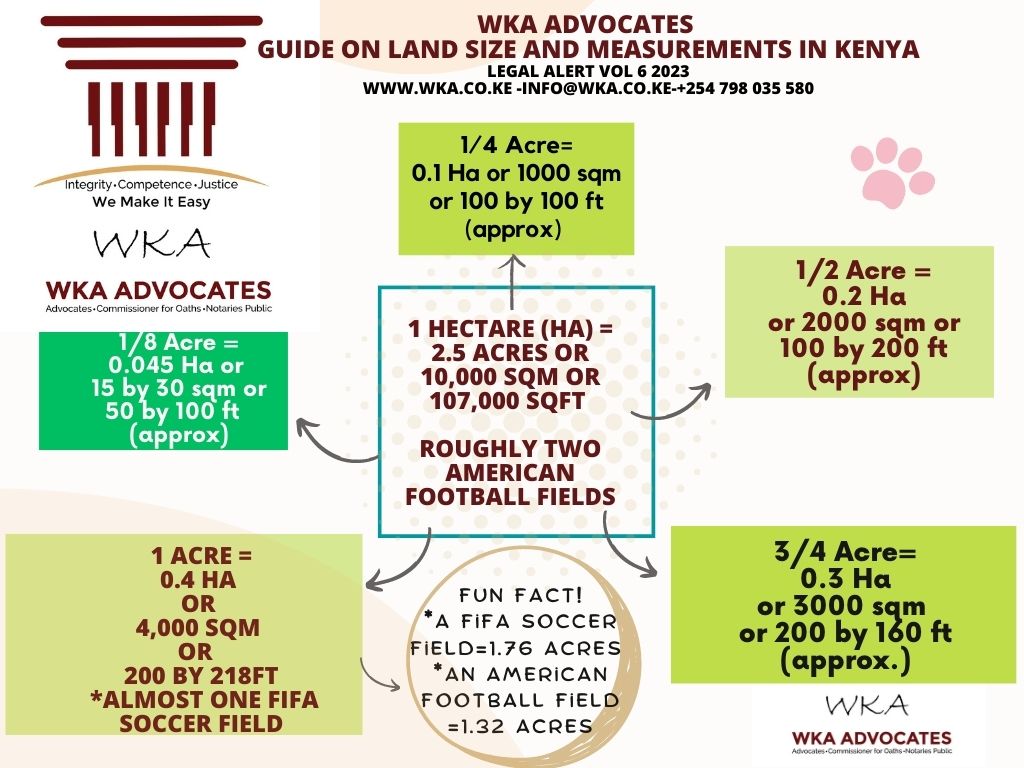
GUIDE ON UNDERSTANDING LAND SIZES AND MEASUREMENTS IN KENYA

WKA ADVOCATES GUIDE ON UNDERSTANDING LAND SIZES AND MEASUREMENTS IN KENYA

Understanding Plot Sizes: The 1/8th Acre Explained

Hey there, land lover!

Do you really know the size of your favorite 1/8th plot, or do you just like the sound of saying “1/8th”? We get it—sometimes, size can be a confusing thing. But fear not, because we’re here to help!

As you search for your dream property, it’s crucial to understand the different plot sizes available to you. We’ve noticed that many buyers may not fully comprehend the difference between an acre and a hectare.

To make things easier, we’ve put together this fun and concise newsletter to give you a better understanding of the various plot sizes available. No more guessing, no more confusion—just pure land knowledge!

Enjoy reading and feel free to share this with your fellow land enthusiasts!

Categories
Uncategorized

Impact of Tripling Capital Gains Tax on Property Sales in Kenya Effective January 1, 2023

Impact of Tripling Capital Gains Tax on Property Sales in Kenya Effective January 1, 2023

The Finance Act of 2022 amended the Income Tax Act, increasing the rate of capital gains tax (CGT) from 5% to 15%, effective January 1, 2023. This change impacts property transfers in Kenya, applying to properties acquired on or before January 2015.

What is Capital Gains Tax?

Capital Gains Tax is imposed on the transfer of property, which includes sales, exchanges, conveyances, or other dispositions of property. It also covers the destruction, abandonment, surrender, cancellation, or forfeiture of property. Examples of properties subject to CGT include land, buildings, securities, and shares.

Determination of CGT Rate

The rate of CGT is determined by the specific circumstances of the transfer. For instance, a firm certified by the Nairobi International Financial Centre Authority that invests KES 5 billion in Kenya and transfers the investment after five years will be subject to the rate effective at the time of investment. If the investment was made before the CGT rate increase, the firm would still pay the previous rate of 5%.

Allowable Expenses for CGT Calculation

Allowable expenses when computing CGT include costs related to the transfer of property such as:

  • Loan/mortgage interest
  • Advertising costs
  • Valuation costs
  • Legal fees
  • Enhancement costs

How to Compute CGT

The net capital gain is calculated by subtracting allowable expenses and any exemptions from the total capital gain. For example, if the total capital gain on a property transfer is KES 10 million and allowable expenses are KES 2 million, the net capital gain is KES 8 million (KES 10 million – KES 2 million). The CGT due would then be 15% of KES 8 million, resulting in a CGT liability of KES 1.2 million (KES 8 million x 15%).

Payment of CGT

To pay CGT in Kenya, the individual or entity responsible for the transfer must file a return with the Kenya Revenue Authority within three months of the transfer. The tax must be paid within 30 days of filing the return.

Exemptions to CGT

Certain transfers are exempt from CGT, including:

  • Transfers for securing a loan
  • Transfers between spouses
  • Transfers of shares listed on the Nairobi Securities Exchange
  • Transfers by a creditor for returning property used as security for a debt or loan

Potential Impacts of Increased CGT

The tripling of the CGT rate to 15% may have several impacts, including:

  • Decreased demand for property, slowing down the real estate market.
  • Decreased supply of property as owners may hold onto their property to avoid higher taxes.
  • Decreased investment in property due to higher tax discouragement.
  • Negative impacts on economic growth, particularly in the construction and real estate industries, and related sectors like lending and insurance.
  • Reduced commissions for property agents as sellers might lower commissions in response to the higher tax burden.

Contact Us

WKA Advocates has a dedicated Corporate Commercial department to assist with understanding the Tax Regime in Kenya. For legal assistance, contact us at:

  • Email: info@wka.co.ke
  • Website: wakilihub.co.ke/
  • Phone: +254 798 03 580
  • Address: Nairobi Hub, Parklands, Valley View Business Park, 6th Floor, City Park Drive, Off Limuru Road.

Conclusion

We hope this information helps in understanding the impact of the increased Capital Gains Tax on property sales in Kenya. Please note that this newsletter provides a general guide and should not be relied upon without legal advice. For further information or legal assistance on compliance or any other legal issue, feel free to contact us.

Authors:

  • William Karoki, Founding Partner
Categories
Uncategorized

Costly Mistakes to Avoid When Purchasing Property in Kenya

Costly Mistakes to Avoid When Purchasing Property in Kenya

  1. Money Matters
    • Don’t send money directly to the seller or their advocate unless advised by your qualified advocate.
    • Don’t pay the whole amount at once. Deposits should be at least 10%.
    • Don’t pay in hard cash! Always ensure there’s a money trail.
  2. Not Having Your Own Lawyer
    • Don’t engage in any property transaction without appointing your own qualified advocate.
    • Your advocate will advise you on the necessary documents and other important experts such as surveyors and valuers.
  3. Relying on Influencers
    • Don’t make a decision to buy land based solely on journalists, social media influencers, pastors, friends, or TV adverts.
    • Influencers cannot perform due diligence on your behalf.
  4. Buying in Secrecy
    • Don’t buy property without informing your family, close friends, confidants, or spouse.
    • They may provide valuable alternative opinions or warn you of potential risks.
  5. Not Doing a Site Visit
    • Don’t buy property without a physical site visit or through your power of attorney or qualified advocate to ensure the land is vacant.
    • Upon your advocate’s advice, engage a qualified surveyor to map out the beacons on a second site visit.

By avoiding these common pitfalls, you can make a more informed and secure property purchase in Kenya. Always seek professional advice and ensure thorough due diligence to safeguard your investment.