Categories
Uncategorized

To Guarantee or Not? Rights of Loan Guarantors in Kenya

Loan Guarantors in Kenya: Should You Guarantee or Not?

So, you’ve joined the SACCO your friend recommended. After building up some savings, the same friend asks you to be their loan guarantor. One afternoon at your favorite four-star kiosk, “kibandaski,” they casually mention needing KES 500,000 for a project back home and ask you to guarantee KES 200,000. Without thinking, you sign the loan forms, wondering, “What could possibly go wrong?”

Months later, your salary and SACCO shares are being deducted to cover your friend’s loan, which they spent on a holiday to the Mara. You’re now left with half your salary while your friend enjoys a luxurious lifestyle.

The Big Question: Should You Guarantee a Loan?

Applicable Laws on Loan Guarantees in Kenya

Loan guarantorship in Kenya is governed by:

  • The Constitution of Kenya, 2010
  • The Law of Contract Act, Cap 23 (LCA)
  • Case law (legal precedents)

What Does Kenyan Law Say About Guarantees?

The Law of Contract Act, Cap 23, defines a guarantee as a written promise by the guarantor to be responsible for a debtor’s obligations. Under Section 3(1) of the LCA:

“No suit shall be brought…unless the agreement…is in writing and signed by the party to be charged.”

In 2019, a proposed amendment to the LCA sought to ensure creditors first exhaust the debtor’s assets before suing the guarantor. However, the President rejected this amendment, citing concerns over its impact on credit availability for SMEs.

Rights of Loan Guarantors in Kenya Before Satisfying Debt

  1. Right to Property: Guarantors have the right to retain their property and cannot be arbitrarily deprived of it.
  2. Type of Guarantee: Guarantees can be “on-demand” (immediate payment) or “conditional” (payment only under certain conditions).
  3. Liability: A guarantor’s liability arises only when the principal debtor defaults.
  4. Right to Demand Payment: Guarantors can demand that the principal debtor pay the guaranteed debt.
  5. Right to Information: Guarantors are entitled to timely and accurate updates from the creditor on the status of the loan.

Effects of Changes in Loan Terms

  • Unauthorized Changes: If the creditor alters the contract without the guarantor’s consent, the guarantor may be discharged from their obligation.
  • Court Rulings: Key cases, like Reid vs. National Bank of Commerce (1971), affirm the guarantor’s right to be informed of changes to the contract.

Creditor’s Duty of Good Faith Towards Guarantors

  • Bad Faith by Creditors: If the creditor colludes with the principal debtor or acts in bad faith, the guarantor may be released from liability.
  • Relevant Case Law: Martin Kirima Baithambu vs. Jeremiah Miriti [2017] emphasizes the importance of creditors acting in good faith.

Defenses and Remedies for Loan Guarantors in Kenya

  • Variation of Contract: Unauthorized contract changes can release the guarantor from their obligations.
  • Release of Security: If the creditor releases the debtor’s security without the guarantor’s consent, the guarantor may no longer be liable.

Recommendations for Guarantors in Kenya

In Kenya, the law generally favors creditors over guarantors. The rejected 2019 amendment sought to redress this by requiring creditors to pursue the debtor’s assets first. Guarantors who pay off the loan can sue the principal debtor for reimbursement under the principle of subrogation.

Before signing any loan guarantee, seek legal advice and conduct thorough due diligence. Understand the potential financial risks of guaranteeing a loan.

For more information or legal assistance regarding loan guarantees or any other legal issues, contact us at:

WKA Advocates

  • Email: info@wka.co.ke
  • Website: wakilihub.co.ke/
  • Phone: +254 798 03 580
  • Address: Valley View Business Park, 6th Floor, City Park Drive, Off Limuru Road, Nairobi
Categories
real estate

How Can a Foreigner Own Property in Kenya?

How Can a Foreigner Own Property in Kenya?

Understanding Property Ownership for Foreigners in Kenya

For foreigners looking to invest in property in Kenya, it’s essential to understand the legal framework governing land ownership. Under the Constitution of Kenya (2010), the Lands Act (2012), and the Land Registration Act (2012), foreigners can own property but with certain restrictions. This article will clarify how foreigners can acquire property, the limitations in place, and common pitfalls to avoid.

Limitations on Property Ownership in Kenya for Foreigners

Foreigners can own property in Kenya only under leasehold tenure, with a maximum lease term of 99 years, as outlined in Article 65(1) of the Constitution. Any lease beyond 99 years is automatically considered a 99-year lease. Additionally, companies are regarded as Kenyan only if they are 100% owned by Kenyan citizens. Companies with foreign shareholders are classified as foreign entities and cannot own freehold land. Trusts cannot bypass these regulations, and any freehold interest held by a foreigner will revert to the state, which will grant a 99-year lease at a nominal rate.

Agricultural Land Ownership for Foreigners

According to the Land Control Act, transactions involving agricultural land are categorized as “controlled transactions” and require consent from the Land Control Board. This board cannot authorize sales, leases, or transfers of agricultural land to foreigners. However, foreign investors can apply for exemptions through a presidential notice in the Kenya Gazette. Public companies with foreign shareholders may also acquire agricultural land under specific conditions.

How to Avoid Legal Pitfalls When Acquiring Property as a Foreigner

Some foreign investors attempt to bypass ownership restrictions by using local shareholders or nominees. These strategies often lead to legal complications. It’s crucial to consult a legal expert to ensure full compliance with Kenyan law.

Types of Property Ownership in Kenya

  1. Public Land: Owned by the government for public use (e.g., national parks, public infrastructure) as defined in Article 62 of the Constitution.
  2. Community Land: Held by communities based on ethnicity or common interests, intended for communal benefit (as per Article 63).
  3. Private Land: Owned by individuals or entities under freehold or leasehold tenure (according to Article 64). Freehold land grants absolute ownership, while leasehold land is held for up to 99 years.

When purchasing property, it is essential to verify that the land is not listed in the Ndung’u Land Report, which records illegally acquired land.

Who Can Sell Property in Kenya?

Property in Kenya can be sold by:

  • Private developers
  • Licensed estate agents and brokers
  • Saccos, churches, and Chamas
  • Cooperatives and financial institutions
  • Trusts, companies, individuals, and communities

Recent Changes in Property Ownership Laws: The Sectional Properties Act 2020

The Sectional Properties Act 2020, in alignment with the Constitution of Kenya 2010, facilitates the division of buildings into individually owned units, with shared common property. This law streamlines property transactions, reduces costs, and enhances protection for unit owners.

Tax Implications When Acquiring or Selling Property in Kenya

  • Stamp Duty: The buyer is required to pay stamp duty, which is 4% for properties in cities and municipalities and 2% for properties in rural areas.
  • Capital Gains Tax (CGT): Sellers must pay a 15% CGT, effective from January 1, 2023, on the transfer of property, land, buildings, securities, and shares.
  • Value Added Tax (VAT): Commercial building sales are subject to VAT at 16%.
  • Miscellaneous Costs: Include loan-related bank fees and mobile money transfer charges.

Legal Assistance for Foreigners Buying Property in Kenya

At WKA Advocates, we offer a dedicated Conveyancing and Real Estate department to assist foreign investors. Whether you’re purchasing residential, commercial, or agricultural property, our team provides comprehensive legal guidance to ensure a smooth transaction.

Contact Us:

  • Email: info@wka.co.ke
  • Website: wakilihub.co.ke/
  • Phone: +254 798 03 580
  • Address: Valley View Business Park, 6th Floor, City Park Drive, Off Limuru Road, Nairobi

Authors:

William Karoki, Founding Partner, WKA Advocates

Categories
Uncategorized

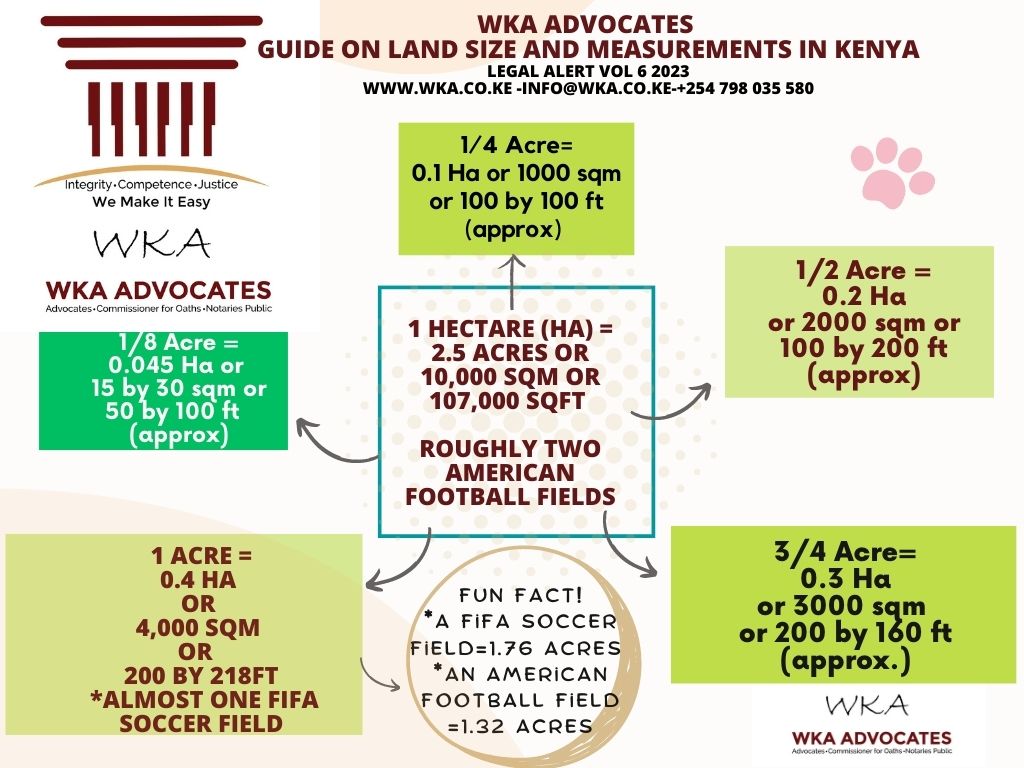
GUIDE ON UNDERSTANDING LAND SIZES AND MEASUREMENTS IN KENYA

WKA ADVOCATES GUIDE ON UNDERSTANDING LAND SIZES AND MEASUREMENTS IN KENYA

Understanding Plot Sizes: The 1/8th Acre Explained

Hey there, land lover!

Do you really know the size of your favorite 1/8th plot, or do you just like the sound of saying “1/8th”? We get it—sometimes, size can be a confusing thing. But fear not, because we’re here to help!

As you search for your dream property, it’s crucial to understand the different plot sizes available to you. We’ve noticed that many buyers may not fully comprehend the difference between an acre and a hectare.

To make things easier, we’ve put together this fun and concise newsletter to give you a better understanding of the various plot sizes available. No more guessing, no more confusion—just pure land knowledge!

Enjoy reading and feel free to share this with your fellow land enthusiasts!

Categories
Uncategorized

Impact of Tripling Capital Gains Tax on Property Sales in Kenya Effective January 1, 2023

Impact of Tripling Capital Gains Tax on Property Sales in Kenya Effective January 1, 2023

The Finance Act of 2022 amended the Income Tax Act, increasing the rate of capital gains tax (CGT) from 5% to 15%, effective January 1, 2023. This change impacts property transfers in Kenya, applying to properties acquired on or before January 2015.

What is Capital Gains Tax?

Capital Gains Tax is imposed on the transfer of property, which includes sales, exchanges, conveyances, or other dispositions of property. It also covers the destruction, abandonment, surrender, cancellation, or forfeiture of property. Examples of properties subject to CGT include land, buildings, securities, and shares.

Determination of CGT Rate

The rate of CGT is determined by the specific circumstances of the transfer. For instance, a firm certified by the Nairobi International Financial Centre Authority that invests KES 5 billion in Kenya and transfers the investment after five years will be subject to the rate effective at the time of investment. If the investment was made before the CGT rate increase, the firm would still pay the previous rate of 5%.

Allowable Expenses for CGT Calculation

Allowable expenses when computing CGT include costs related to the transfer of property such as:

  • Loan/mortgage interest
  • Advertising costs
  • Valuation costs
  • Legal fees
  • Enhancement costs

How to Compute CGT

The net capital gain is calculated by subtracting allowable expenses and any exemptions from the total capital gain. For example, if the total capital gain on a property transfer is KES 10 million and allowable expenses are KES 2 million, the net capital gain is KES 8 million (KES 10 million – KES 2 million). The CGT due would then be 15% of KES 8 million, resulting in a CGT liability of KES 1.2 million (KES 8 million x 15%).

Payment of CGT

To pay CGT in Kenya, the individual or entity responsible for the transfer must file a return with the Kenya Revenue Authority within three months of the transfer. The tax must be paid within 30 days of filing the return.

Exemptions to CGT

Certain transfers are exempt from CGT, including:

  • Transfers for securing a loan
  • Transfers between spouses
  • Transfers of shares listed on the Nairobi Securities Exchange
  • Transfers by a creditor for returning property used as security for a debt or loan

Potential Impacts of Increased CGT

The tripling of the CGT rate to 15% may have several impacts, including:

  • Decreased demand for property, slowing down the real estate market.
  • Decreased supply of property as owners may hold onto their property to avoid higher taxes.
  • Decreased investment in property due to higher tax discouragement.
  • Negative impacts on economic growth, particularly in the construction and real estate industries, and related sectors like lending and insurance.
  • Reduced commissions for property agents as sellers might lower commissions in response to the higher tax burden.

Contact Us

WKA Advocates has a dedicated Corporate Commercial department to assist with understanding the Tax Regime in Kenya. For legal assistance, contact us at:

  • Email: info@wka.co.ke
  • Website: wakilihub.co.ke/
  • Phone: +254 798 03 580
  • Address: Nairobi Hub, Parklands, Valley View Business Park, 6th Floor, City Park Drive, Off Limuru Road.

Conclusion

We hope this information helps in understanding the impact of the increased Capital Gains Tax on property sales in Kenya. Please note that this newsletter provides a general guide and should not be relied upon without legal advice. For further information or legal assistance on compliance or any other legal issue, feel free to contact us.

Authors:

  • William Karoki, Founding Partner
Categories
Uncategorized

Costly Mistakes to Avoid When Purchasing Property in Kenya

Costly Mistakes to Avoid When Purchasing Property in Kenya

  1. Money Matters
    • Don’t send money directly to the seller or their advocate unless advised by your qualified advocate.
    • Don’t pay the whole amount at once. Deposits should be at least 10%.
    • Don’t pay in hard cash! Always ensure there’s a money trail.
  2. Not Having Your Own Lawyer
    • Don’t engage in any property transaction without appointing your own qualified advocate.
    • Your advocate will advise you on the necessary documents and other important experts such as surveyors and valuers.
  3. Relying on Influencers
    • Don’t make a decision to buy land based solely on journalists, social media influencers, pastors, friends, or TV adverts.
    • Influencers cannot perform due diligence on your behalf.
  4. Buying in Secrecy
    • Don’t buy property without informing your family, close friends, confidants, or spouse.
    • They may provide valuable alternative opinions or warn you of potential risks.
  5. Not Doing a Site Visit
    • Don’t buy property without a physical site visit or through your power of attorney or qualified advocate to ensure the land is vacant.
    • Upon your advocate’s advice, engage a qualified surveyor to map out the beacons on a second site visit.

By avoiding these common pitfalls, you can make a more informed and secure property purchase in Kenya. Always seek professional advice and ensure thorough due diligence to safeguard your investment.

Categories
Uncategorized

Fees, Costs, and Taxes Payable When Buying Land or Houses in Kenya (Conveyancing)

Fees, Costs, and Taxes Payable When Buying Land or Houses in Kenya (Conveyancing)

Buyer’s (Purchaser) Costs

  1. Purchase Price
    • Unless advised otherwise by your qualified advocate, let a qualified advocate hold all funds as a stakeholder, not an agent, or jointly by both parties, or by a third party in an escrow account. The purchase price is ideally paid as follows:
      • Deposit: 10% (or higher) of the purchase price on or before execution of the sale/lease agreement.
      • Balance: Remaining purchase price on completion (exchange of documents, transfer of original title, etc.).
      • If it is a gift, state clearly that it is a gift. Never pay in hard cash! Check our Vol 2, 2023.
  2. Professional Fees
    • Qualified Advocate: Minimum legal fees are regulated by the Advocates Remuneration Order (ARO) and based on the value of the subject matter. Avoid agreements for KES 2,000.
    • Qualified Valuer: To value the property.
    • Qualified Surveyor: To obtain maps/mutation at the Ministry (Maps cost about USD 4/KES 400) and resurvey the property.
  3. Nominal Duty to Stamp Agreement
    • The sale/lease agreement must be stamped to be used in a court of law in case of fraud.
    • Cost: Usually USD 20-50/KES 200-500 (expressed in denominations of KES 20, referred to as pounds).
    • The agreement will be stamped with a red dye stamp (in Kenyan pounds).
    • Must be stamped within 30 days, or penalties will accrue.
  4. Stamp Duty
    • 4% for properties within cities and municipalities.
    • 2% of the value for properties outside municipalities/cities.
    • Your advocate will advise on properties exempt from stamp duty.
  5. Bank Fees & Miscellaneous Costs
    • If taking a loan, the bank will charge the property. Charges/mortgages attract 0.1% of the amount secured.
    • Bank miscellaneous costs (RTGS/excise tax).

Seller’s (Vendor) Costs

  1. Land Rent
    • Payable to the government (if leasehold).
  2. Land Rates
    • Payable to the county government.
    • Includes all penalties for late payments.
    • Seller to provide buyer with all clearance certificates and accompanying receipts/bank cheques.
  3. Utility Bills
    • All pending water and electricity bills.
    • All the above costs will be apportioned between buyer and seller. Your advocate will advise on this.
  4. Commission
    • Payable to duly licensed estate agents/brokers.
  5. Partitioning or Subdivision of Land/Building Plans
    • Costs of engaging a surveyor, physical planner, qualified engineer/architect/quantity surveyor.
  6. Consents/Approvals
    • All costs necessary for obtaining consents referred to in our Vol 2 (Commissioner of Lands, Land Control Board, Change of User, County Council Building Permits, etc.).
  7. Probate/Succession Costs
    • In case of succession matters, all probate fees to obtain proper title.
  8. Capital Gains Tax (CGT)
    • Check our Vol 1, 2023.
    • The rate of tax is 15% of the net gain.
    • Your advocate will advise on how to calculate tax and properties exempt.
  9. Bank Loan Discharge Fees
    • If the owner had taken a loan against the property, it must be discharged with consent by the bank. Discharges/reconveyances cost 0.05% of the amount secured.
    • Bank miscellaneous costs/excise tax.
  10. VAT (16%) on Sale of Commercial Buildings
    • On January 17, 2019, KRA was granted a stay of execution on the High Court judgment (civil suit 541 of 2015) until the presumed appeal is heard. For now, VAT on the sale of commercial buildings remains payable.

Buying a House/Apartment + Costs

  • Note that for houses and apartments, the first agreement is called an offer letter, and the sale agreement is known as an agreement of lease. The purchase price is referred to as lease premium.
  • After the passage of the Sectional Properties Act No. 21 of 2020, buyers/owners of apartments will receive a title deed rather than a certificate of lease. Buyers/owners will also have one share in a corporation to manage the common areas.

Seller’s Lawyer Legal Fees

  • 1% of the purchase price.
  • Can be renegotiated by your qualified advocate.

Other Costs

  • Disbursement for Water Infrastructure Costs
  • Electricity Infrastructure Costs: Normally referred to as electricity/power meter & deposit & connection charges.
  • Provisional Service Charge and/or Service Charge: For the first 3 to 5 months, expressed as a percentage of the lease premium.
  • Initial Provisional Infrastructure Levy Deposit: May not be charged.
  • Cost of Transfer of Allotment and Setting Up of Management Corporation
  • VAT on Fees and Disbursements: VAT is payable on legal fees and disbursements at a rate of 16%.
  • Registration of Documents and Pre/Post Search Costs: Green card search and normal search before and after obtaining title, and registration of transfer documents to obtain new title/sectional title.

For more details, visit WKA Advocates.

Categories
Uncategorized

WKA Advocates’ Guide to Avoiding Pitfalls When Buying Land or a House in Kenya

WKA Advocates’ Guide to Avoiding Pitfalls When Buying Land or a House in Kenya

Don’ts

  1. Don’t send money directly to the seller (vendor) or their agent unless advised by your advocate. Avoid paying in hard cash to ensure there is a money trail.
  2. Don’t buy or sell/lease land or apartments without involving a qualified advocate. Your advocate will guide you and recommend other essential experts like qualified surveyors and valuers.
  3. Don’t make a decision to buy land based solely on radio and TV adverts or media influencers. Conduct a simple Google search for any cases or complaints against the sellers.
  4. Don’t ignore this advice, or it may end in premium tears.

Who Sells Land/Houses in Kenya?

  • Reputable real estate firms (Ensure they are licensed and check for any court cases against them)
  • Saccos, churches, chamas, cooperatives, financial trusts, companies, individuals, and communities
  • Private developers and licensed estate agents/brokers on behalf of owners for a commission

Do’s

  1. Do a first site visit physically or through your power of attorney to ensure the land is vacant.
  2. Upon your advocate’s advice, engage a qualified surveyor to map out the beacons on a second site visit.
  3. Inform your confidants/family/spouse of your intentions to buy/sell land or an apartment. They may provide valuable opinions or better options.
  4. After a phone call or oral chat, always write an email/WhatsApp/text message to confirm what was discussed. Ensure you have written evidence or minutes of the meeting.

What Are the Types of Land Classification?

  • Private, Public, or Community Land: Refer to the NDUNG’U LAND REPORT to ensure the land was not acquired illegally.
  • Freehold or Leasehold: Freehold indicates absolute proprietorship/ownership, often for agricultural land. Leasehold is for a term like 99 years.
  • Apartments/Townhouses: Classified as sectional properties.

Important Notes

  • A certificate of allotment/share certificate is not a title deed. Do not be deceived.
  • There is no such thing as a “ready title” or “clean title”. The title must be legally transferred to you.
  • Hiring a qualified advocate is not expensive. Advocate fees are guided by the Advocates’ Remuneration Order. Better safe than sorry! Avoid any agreements claiming to cost USD 30/KES 3,000.
  • All agreements involving land/houses must be in writing, signed, and properly witnessed.

Which Consents Do You Need?

  • Land Control Board Consent: The board consists of assistant county commissioners and village elders. A controlled transaction is declared void if this consent is not obtained within six months. Cost: USD 10/KES 1,000 or special sitting USD 50/KES 5,000.
  • County Land Management Board Consent
  • Spousal Consent: As they have matrimonial property rights.
  • Financial Institutions (Banks): If the property was charged (used to secure a loan).
  • Other Authorities: Kenya Airports Authority (KAA), Kenya Railways, Kenya Civil Aviation Authority (KCAA), Kenya Ports Authority (if land is adjacent), and trustees of national parks.

For further information or legal assistance, please contact us at info@wka.co.ke, visit wakilihub.co.ke/, or call +254 798 03 580. Our Nairobi Hub is located at Parklands, Valley View Business Park, 6th Floor, City Park Drive, Off Limuru Road.

Authors:

  • Founding Partner: William Karoki
  • Lawyer: Florence Mwende
Categories
Uncategorized

3 Bills Rejected!

3 Bills Rejected!

President Uhuru Kenyatta rejected the Information Communication Technology Practitioners Bill (ICT), 2020. Sections of Kenyans urged Cabinet Secretary Joe Mucheru to advise President Kenyatta against signing the bill, stating it would undermine players in the sector. The contentious bill sought to require all local ICT practitioners to be licensed and registered by a council. Additionally, the Insurance Professionals Registration Bill of 2020 and the Higher Education Loans Bill of 2020 were also rejected and sent back to Parliament with memoranda.

10 Bills Assented into Law!

President Uhuru Kenyatta signed into law 10 bills with the following key features:

  1. 2022 Appropriation Bill and the Supplementary Appropriation Bill 2022
    • Authorizes the issue of funds from the Consolidated Fund for the service year ending on June 30, 2022.
  2. Finance Bill 2022
    • Aims to raise revenue for the Sh3.33 trillion budget for the 2022/23 financial year.
    • Parliament rejected proposed increases in taxes on maize and wheat flour, wines, spirits, and motorcycles.
    • The proposed increase in taxes on beauty products and jewelry was retained.
  3. Radiographers Bill 2021
    • Establishes a legislative framework for the training, registration, and licensing of radiographers.
  4. National Electronic Single Window Bill 2021
    • Facilitates trade and commerce through a single entry point for processing import and export documents and making electronic payments.
  5. Traffic (Amendment) Bill 2021
    • Amends the Traffic Act to align with the Constitution and improve the implementation of traffic laws.
  6. National Government Development Fund (Amendment) Bill
    • Provides an accountable process for the allocation of funds for the National Government Constituencies Development Fund Board.
  7. Supreme Court (Amendment) Bill of 2022
    • Updates the Supreme Court Act to align with current practices and improve efficiency.
  8. County Allocation of Revenue Bill 2022
    • Allocates revenue raised nationally among county governments for the 2022/23 financial year.
  9. Mental Health (Amendment) Bill 2020
    • Ensures the rights of individuals with mental disorders are protected and establishes sufficient mental health facilities at both national and county levels.

For more information or legal assistance on compliance or other legal issues, please contact us at info@wka.co.ke or visit wakilihub.co.ke/. Our Nairobi hub is located at Parklands, Valley View Business Park, 6th Floor, City Park Drive, Off Limuru Road.

Categories
Uncategorized

President Kenyatta Announces 12% Minimum Wage Increase for Kenyan Workers

President Kenyatta Announces 12% Minimum Wage Increase for Kenyan Workers

The Employment (Amendment) Act 2022 was signed into law on April 4, 2022, by His Excellency the President of Kenya. The following changes took effect on April 22, 2022.

Key Changes:

  1. Streamlined Job Application Process:
    • Employers will no longer require job applicants to produce clearance and compliance certificates, such as certificates of good conduct, EACC clearance, and HELB clearance, at the initial point of a job application.
    • This amendment aims to ease the financial burden on job applicants, especially young, underprivileged individuals, who previously had to spend around KES 6,000 to acquire these certificates.
  2. Elimination of Application Fees:
    • The fees for applying for clearance and compliance certificates have been scrapped. It is now free to apply for these certificates from relevant institutions like HELB.
  3. Public Service Applicants:
    • Job applicants for public service positions will still be required to submit clearance and compliance certificates.
  4. Post-Offer Requirements:
    • Successful job applicants who receive a letter of offer will still need to submit the required clearance and compliance certificates.
    • Employers have the right to withdraw letters of offer if the prospective employees do not submit the requested certificates.

Recommendations for Employers:

  • Employers should review and update their Human Procedures and Policies Manual and Employment Contracts to align with these changes and ensure compliance with the law.

Please note that the contents of this newsletter are intended to provide a general guide to the subject matter. It should not be relied upon without legal advice. For further information or assistance on compliance or any other legal issues, please contact us at info@wka.co.ke.

Visit us at:
WKA Kenya
Nairobi Hub: Parklands, Valley View Business Park, 6th Floor, City Park Drive, Off Limuru Road
Website: wakilihub.co.ke/

Categories
Uncategorized

DOES YOUR LAWYER TALK TO YOU? DO YOU UNDERSTAND?

Communicating Effectively with Clients: Simplifying Legal Opinions

Our clients, most of whom are not lawyers, often perceive that lawyers use complex language. This perception is why law schools now emphasize the use of plain English, an area where many lawyers struggle.

Having worked both in a law firm and as in-house counsel, I have had the privilege of interacting with those who issue instructions to lawyers—CEOs, CFOs, government officials, and other managers. A common theme prevails: they simply do not have the time or energy to read through 5-20 pages of dense legalese. They are more concerned with the solutions and recommendations you provide.

Think about it. How often has a client asked you to explain or summarize the advice in your legal opinion? A wise lawyer will summarize the opinion in an email or place it on the first page of the document. In-house counsel are often overwhelmed and do not have time to read the entire document. They rely on the summary you provide over the phone or via email.

Law school teaches us that every legal opinion must follow a chronological order of facts, issues, rules, application of the law/analysis, and conclusion (FIRAC). This method has remained unchanged since the 1600s. While some innovative lawyers have tweaked their opinions to include summaries, the general format remains the same.

Times have changed, and so have the ways we consume information. There is a perception that lawyers are stuck in the past, using outdated terms like “therein” and “wherein.” I strongly believe there should be a radical reform of legal opinions to benefit the client. Making information more appealing and accessible would save time and resources for both parties.

For starters, we could move away from dense prose and use tables or matrices to explain information. Additionally, we could use audio formats to package legal opinions, allowing clients to listen to them. Podcasts, videos, or PowerPoint slides could enhance the consumption of this information. A comprehensive review of how lawyers present information to clients is necessary. For instance, I have not seen the use of emojis in legal documents, yet they are common in everyday communication. The law should reflect changing societal needs.

Current legal opinions are in the dark ages of the Nokia era, while the world has moved to the iOS/Android period. Let us embrace change and develop more engaging ways to present our work.

At PROW, we strive to communicate with our clients by issuing brief and succinct legal opinions, focusing on solutions rather than merely restating the law.

For assistance with any legal issues or general advice, please contact us at info@wka.co.ke.